HOA Homeowners' Rights Task Force
Thank you for visiting the community engagement tool for the HOA Homeowners’ Rights Task Force.
Pursuant to HB23-1105, this project has now concluded. On behalf of the Department of Regulatory Agencies and the Division of Real Estate, thank you for your interest and participation.

We're looking for your feedback on how HOAs are working here in Colorado.
The Colorado General Assembly recently passed HB23-1105: HOA Rights Task Force, creating two task forces aimed to investigate and present written reports on issues affecting those that work or live in HOAs in Colorado.
The HOA Rights Task Force’s main priorities are to study issues confronting HOA homeowners' rights, including:
Homeowners' associations' fining authority and practices
Foreclosure practices
Communications with homeowners
Availability and method of making certain documents available to HOA homeowners in the association
If you live in Colorado and work or reside in a homeowners association – we ask you to take part in our HOA stakeholder engagement activities (below). By taking our community survey or submitting your personal story, you are helping to shape the future of HOAs in Colorado.
All responses collected will be used to inform a final report to be presented to the Colorado General Assembly, the Governor’s Office, and the public.
We're looking for your feedback on how HOAs are working here in Colorado.
The Colorado General Assembly recently passed HB23-1105: HOA Rights Task Force, creating two task forces aimed to investigate and present written reports on issues affecting those that work or live in HOAs in Colorado.
The HOA Rights Task Force’s main priorities are to study issues confronting HOA homeowners' rights, including:
Homeowners' associations' fining authority and practices
Foreclosure practices
Communications with homeowners
Availability and method of making certain documents available to HOA homeowners in the association
If you live in Colorado and work or reside in a homeowners association – we ask you to take part in our HOA stakeholder engagement activities (below). By taking our community survey or submitting your personal story, you are helping to shape the future of HOAs in Colorado.
All responses collected will be used to inform a final report to be presented to the Colorado General Assembly, the Governor’s Office, and the public.
Share Your HOA Story
How have you been impacted by an HOA?
Share your story and help us better understand how homeowner association rules or regulations have had a positive or negative impact on you. Feel free to share any concerns, complaints, ideas or advice that relates to your experience with HOA's in Colorado.
Thank you for sharing your story with the HOA Homeowners' Rights Task Force.
-
Share Shouting HOA Board Members on Facebook Share Shouting HOA Board Members on X (formerly Twitter) Share Shouting HOA Board Members on Linkedin Email Shouting HOA Board Members link
Shouting HOA Board Members
by PaulG, over 2 years agoLoud shouting at Hampden Court homeowners by HOA Board members at Board Meetings has been a problem for several years, as well as other unethical behavior.
Here is a recent email about the matter sent to the RowCal Manager.
Tanya Valis,
At the last HOA Board Meeting in February, board members were shouting at homeowners, and even each other. This behavior is extremely unprofessional and unethical. I have documented board members shouting during HOA Board meetings in the past in a small room where it is not necessary, nor at a virtual meeting. And, it is angry shouting which is... Continue reading
Loud shouting at Hampden Court homeowners by HOA Board members at Board Meetings has been a problem for several years, as well as other unethical behavior.
Here is a recent email about the matter sent to the RowCal Manager.
Tanya Valis,
At the last HOA Board Meeting in February, board members were shouting at homeowners, and even each other. This behavior is extremely unprofessional and unethical. I have documented board members shouting during HOA Board meetings in the past in a small room where it is not necessary, nor at a virtual meeting. And, it is angry shouting which is disturbing to all present.
Please make sure that proper ethics and decorum is conducted at all times by HOA Board members, as stipulated by our Bylaws and codes of conduct.
Sincerely, Paul Grundy
Hampden Court 3480 S Akron #10 Denver, CO 80231
CC: https://leg.colorado.gov/bills/hb23-1105
https://engagedora.org/hoa-task-force
-
Share Thank You Task Force on Facebook Share Thank You Task Force on X (formerly Twitter) Share Thank You Task Force on Linkedin Email Thank You Task Force link
Thank You Task Force
by gvito, over 2 years agoI have spent probably too many hours of my life listening to the HOA Task Force meetings. They finished their work on Friday. Regardless of my initial skepticism, many of their conclusions and suggestions were well-thought-out and some might be an improvement over the current situation.
However, I am quite disappointed that the Colorado Legislators seldom if ever attended, even after the meeting dates were changed to accommodate their schedules. I thought they were willing to listen to all sides of the debate about what HOAs should be able to do, but that obviously was not the case. That is... Continue reading
I have spent probably too many hours of my life listening to the HOA Task Force meetings. They finished their work on Friday. Regardless of my initial skepticism, many of their conclusions and suggestions were well-thought-out and some might be an improvement over the current situation.
However, I am quite disappointed that the Colorado Legislators seldom if ever attended, even after the meeting dates were changed to accommodate their schedules. I thought they were willing to listen to all sides of the debate about what HOAs should be able to do, but that obviously was not the case. That is further proven by the fact that bills were introduced regarding foreclosure, etc. without even the courtesy of attending a Task Force meeting to tell the members what had been proposed.
It seems the Legislators are fixated on the notion that HOAs are eagerly and often foreclosing on homes in Colorado, which members of the Task Force noted is not the case. Foreclosures are actually rare, and I believe, sometimes that outcome is better for the remainder of the homeowners in the HOA.
The one foreclosure I have been part of during my time on an HOA Board (over 6 years) was halted when the homeowner paid all that she owed hours before the Sheriff's Auction was scheduled. That homeowner is now in arrears again and was responsible last summer for over $14,000 in vandalism damages to an outdoor electric panel in our association. The dues-paying homeowners paid for that repair and 12 units were without power for portions of two days. Since the Legislators believe that no one should ever lose their home regardless of what they do or don't do, I am more than certain that the members of our association will continue to pay this person's freight. No one has asked them if they want to provide snow removal, water, landscape care, and building maintenance, plus paying for vandalism, for that unit without any hope of recompense.
Again, my thanks to the Task Force members.
-
Share HOA Homeowners' Rights Taskforce Final Meeting on Facebook Share HOA Homeowners' Rights Taskforce Final Meeting on X (formerly Twitter) Share HOA Homeowners' Rights Taskforce Final Meeting on Linkedin Email HOA Homeowners' Rights Taskforce Final Meeting link
HOA Homeowners' Rights Taskforce Final Meeting
by HOA United, over 2 years ago
Today was the last meeting for the HOA Homeowners' Rights Taskforce. Thanks to all the Task Force volunteers for their engagement! Today's list of ~50 items was impressive and it provided a tangible sense of the culmination of many months of deliberation.
🎗️ Have you taken DORA's community association / HOA survey? The results are priceless (current through December 2023). Please consider this Board Meetings survey. The way meetings function is critical, wouldn't you agree?!
🤝🗣️🔊Homeowners: please connect with other homeowners! That's the way to make progress. No matter if you live in a condo, co-op... Continue reading
Today was the last meeting for the HOA Homeowners' Rights Taskforce. Thanks to all the Task Force volunteers for their engagement! Today's list of ~50 items was impressive and it provided a tangible sense of the culmination of many months of deliberation.
🎗️ Have you taken DORA's community association / HOA survey? The results are priceless (current through December 2023). Please consider this Board Meetings survey. The way meetings function is critical, wouldn't you agree?!
🤝🗣️🔊Homeowners: please connect with other homeowners! That's the way to make progress. No matter if you live in a condo, co-op or HOA, other homeowners can help YOU figure out how to improve your community. This engagement tool is enlightening and entertaining. Thanks to DORA for providing it.
Sincerely,
HOA (Homeowners of America) United
-
Share HOA Hail Claim Assessment Deductible - not being assessed equally as a common expense on Facebook Share HOA Hail Claim Assessment Deductible - not being assessed equally as a common expense on X (formerly Twitter) Share HOA Hail Claim Assessment Deductible - not being assessed equally as a common expense on Linkedin Email HOA Hail Claim Assessment Deductible - not being assessed equally as a common expense link
HOA Hail Claim Assessment Deductible - not being assessed equally as a common expense
by SUMARE, over 2 years agoMy pre-CCIOA community that has both condo buildings and townhomes experienced a hail event last June. The Association's insurance policy contains an endorsement for the specific peril of wind/hail. The endorsement carries a 5% deductible as part of the total insurance proceeds and is based on the valuation of all buildings, for which owners have been notified to carry H06 insurance annually. The Association insurance is for Replacement Cost Value coverage on all buildings and was paid for by all Owners. The policy windstorm or hail deductible for the policy is calculated separately for, and applies separately to, each building... Continue reading
My pre-CCIOA community that has both condo buildings and townhomes experienced a hail event last June. The Association's insurance policy contains an endorsement for the specific peril of wind/hail. The endorsement carries a 5% deductible as part of the total insurance proceeds and is based on the valuation of all buildings, for which owners have been notified to carry H06 insurance annually. The Association insurance is for Replacement Cost Value coverage on all buildings and was paid for by all Owners. The policy windstorm or hail deductible for the policy is calculated separately for, and applies separately to, each building that sustains loss or damage. Specific insurance covers each building under a separate limit of insurance and calculates the net claim after the 5% deductible has been met -- not how much each owner will be assessed. The assessment is based on the 5% Deductible of the valuation of the property, regardless of how many buildings sustained damage.
The first assessment letters for owners to submit to insurance for our H06 loss assessment coverage were sent February 15, 2024, and properly assessed the 5% deductible amount in an equal amount for all townhome owners and an equal amount for all condo owners based on the valuation of all the buildings. Loss Assessment is triggered when the entire community is assessed for a loss that could have been covered for insurance but was not. The 5% deductible is part of the terms of the wind/hail endorsement terms of the policy.
New roofs were installed on one-third of the buildings almost 3 years ago and were paid out of our common element reserves. Those buildings were not included in the Net Claim because they did not sustain damage, so the Net Claim amount awarded is based on the remaining two-thirds of the buildings on the property that were damaged; however, the roofs are Common Elements and thus a Common Expense for All Owners.
Specific insurance is a type of property insurance in which only one individual property is covered by the policy, which is why each building has been adjusted - to determine whether the damage to a specific building has met the 5% deductible amount and thus how much the insurance company is going to pay – not how much each owner will be assessed. The assessment is based on the 5% Deductible of the value of the property, regardless of how many or which buildings sustained damage.
The association attorney "got involved" and decided to invoke a Reconstruction Assessment provision of the PUD Declaration and apply the assessment only to Owners of the damaged building. He sent out revised assessment letters on the firm's letterhead advising the townhome owners "an error had been made by the attorney" on the assessment amount calculation. The attorney's revised letters calculated the assessment amount based on the "deductible" calculated by the adjuster for each specific building that was damaged and divided that among the 4-6-or-8-unit owners in each building.
Our PUD Declaration provides for a Reconstruction Assessment that may be levied against owners in the event of damaged or destroyed buildings, without owner approval, which is the provision the attorney is invoking. The structures/ townhome buildings were Not destroyed. The claim is for Common Element Roofs and the building deductible used in the adjustor's specific building calculation to determine the Net Claim amount insurance paid, should not be confused with the 5% deductible based on the valuation of all buildings that is the proper amount all owners should be assessed proportionately.
The attorney sent out revised letters to owners of buildings that sustained no damage telling them the deductible does not apply to their units and any H06 claim money that had been received by the management company was returned.
Condominium owners are being charged for the condo building roof repairs, even though only 4 units have roofs above, and also the detached garage building. Condo owners own the airspace inside their units, yet our revised assessment includes the condo building roofs and detached garage buildings owned by the Association. The Condo buildings and garage buildings are common elements, and the repair and replacement of roofs is a common expense! The condos don't have a reconstruction assessment, yet that is what we are being charged. The condos Under this scenario, the condo buildings would not have any assessment! The condo owners only have an assessment if the common element assessment of the 5% wind hail deductible applies. The common elements of the condos are owned together and cannot be separated, yet, the condo assessment is based on two buildings, not three.
The Association's insurance policy covers all owners and all buildings and was paid for by all members of the association. It includes a wind / hail endorsement specific to a hail event claim that includes a 5% deductible based on the valuation of all buildings, thus all owners should pay to repair the common element roofs.
The attorney refuses to look at anything except the Reconstruction Assessment of the PUD Declaration (which can be assessed without owner approval) and won't consider Special Assessment provision for Common Elements, which normally requires 67% owner approval. He also refuses to look at defined property terms in the Declarations. Because the insurance policy has a separate 5% deductible of the valuation of all buildings for the specific peril of wind/hail, no further approval of the assessment is needed.
The attorney blamed the mistake on our documents; that they are so confusing, and we really need to revi$e them. I believe the attorney is creating this mess as a prelude to make us revise our documents and opt into CCIOA so the president can set the annual assessment.
HELP! What can an owner do to force the association to assess the proper amount without hiring an attorney? Is there a way to hold the attorney accountable for his "error"?
-
Share Flooding private property from nearby ditch on Facebook Share Flooding private property from nearby ditch on X (formerly Twitter) Share Flooding private property from nearby ditch on Linkedin Email Flooding private property from nearby ditch link
Flooding private property from nearby ditch
by Caldwell , over 2 years agoI live in a HOA subdivision. In this subdivision 1/4 of the homes on the property get flooded every year. The stockholders says it’s the homeowners responsibility and the ditch owners are not going to do anything about it.PLEASE HELP!!!!!
I live in a HOA subdivision. In this subdivision 1/4 of the homes on the property get flooded every year. The stockholders says it’s the homeowners responsibility and the ditch owners are not going to do anything about it.PLEASE HELP!!!!!
-
Share Special Treatment on Facebook Share Special Treatment on X (formerly Twitter) Share Special Treatment on Linkedin Email Special Treatment link
Special Treatment
by gvito, over 2 years agoIt looks like the members of the Task Force will soon complete their work. I will be interested to see the final report. As a faithful dues-paying member of an HOA I need to understand why the bulk of the attention of the Task Force and those who write here is in sympathy with and advocating for those who do not pay their dues. Perhaps I am confused, but it seems to me that adults who manage to jump through all the hoops to purchase a home including filling out massive amounts of paperwork, attending a closing, paying earnest money... Continue readingIt looks like the members of the Task Force will soon complete their work. I will be interested to see the final report. As a faithful dues-paying member of an HOA I need to understand why the bulk of the attention of the Task Force and those who write here is in sympathy with and advocating for those who do not pay their dues. Perhaps I am confused, but it seems to me that adults who manage to jump through all the hoops to purchase a home including filling out massive amounts of paperwork, attending a closing, paying earnest money, etc. ought to be able to understand that they need to pay their dues and that not paying will have consequences. Is it the job of the Colorado Legislature to create a special office to work with people who don't pay their other bills? I think that if more of those who pay their assessments on time each month watched the Task Force, many would be appalled to realize that there is no one who is looking out for them. I see in a "story" today that a writer thinks a special office should be created to work with folks who don't pay their dues. Is there a special office for folks who do pay and maybe have to cut their budget or make other sacrifices to pay? I am afraid that in another couple of years with even more legislation and new Task Forces, not paying assessments will be made so easy that even those of us who pay, will realize we are being played for a fool. Especially for us condo dwellers, this could create the worst-case scenario. Once paying assessments becomes optional how will we be able to insure or maintain our buildings? Our HOA needs every dollar of the assessments just to stay afloat. -
Share Ideas for Task Force Consideration on Facebook Share Ideas for Task Force Consideration on X (formerly Twitter) Share Ideas for Task Force Consideration on Linkedin Email Ideas for Task Force Consideration link
Ideas for Task Force Consideration
by LK, over 2 years agoThank you for your hard work on the HOA task force. Based on the directives of HB23-1105, your committee discussions, homeowner experiences, and expert testimony, please accept the following ideas for your consideration:
EDUCATION
- Review Colorado HOAs which are non-compliant with the registration and renewal process. Impose fines/penalties for failure to register or renew. Consider increasing the registration fee.
- Create an outreach program in DORA HOA Center along with the registration process encouraging Board of Directors to attend an initial one-hour information session reviewing DORA HOA, CCIOA, major responsibilities.
- Create an outreach program in DORA HOA Center encouraging Community Association... Continue reading
Thank you for your hard work on the HOA task force. Based on the directives of HB23-1105, your committee discussions, homeowner experiences, and expert testimony, please accept the following ideas for your consideration:
EDUCATION
- Review Colorado HOAs which are non-compliant with the registration and renewal process. Impose fines/penalties for failure to register or renew. Consider increasing the registration fee.
- Create an outreach program in DORA HOA Center along with the registration process encouraging Board of Directors to attend an initial one-hour information session reviewing DORA HOA, CCIOA, major responsibilities.
- Create an outreach program in DORA HOA Center encouraging Community Association Manager education and certification.
- Require a brief fact sheet explaining HOAs and their advantages and disadvantages when a contract to buy in an HOA community is initiated.
COMMUNICATION
- Empower within DORA HOA Information and Resource Center an Ombudsman office to improve communication to resolve disputes and questions.
- Require all homeowners in HOAs and Community Association Managers to supply a current preferred method of communication to enable the DORA HOA Ombudsman office to establish assistance to resolve issues.
- In situations not resolved by the Ombudsman office, consider a requirement of a referral to the Colorado Judicial Branch Office of Dispute Resolution which has affordable access to qualified mediators who specialize in issues related to common interest communities.
- Establish a Resource Office in DORA HOA Center for homeowners with unpaid dues and fines to coordinate assistance. Require referrals from HOAs and CAMs to avoid foreclosures.
FINANCIAL RESPONSIBILITY
- Inadequate maintenance and replacement of property can result in an unsafe environment, higher repair costs, and unexpected assessments that can burden homeowners and create a cash-flow crisis.
- Require all HOAs to address the need for reserves with the ownership at least once a year, and at a minimum, establish a reserve target of at least 25% of their annual budget.
SAFE AND EQUITABLE ENVIRONMENT
- Discussion revolved around unintended consequences of HB22-1137. Review the effects of this bill on the fair treatment, safe environment, and a remedy system for violations to protect homeowners in Colorado HOA communities. Consider immediate remedy of health and safety violations and escalating fines in some situations. Add an initial grace period to attempt communication with the owner regarding delinquency prior to posting the notice on the door.
-
Share Re: Regulation of HOA Management Companies on Facebook Share Re: Regulation of HOA Management Companies on X (formerly Twitter) Share Re: Regulation of HOA Management Companies on Linkedin Email Re: Regulation of HOA Management Companies link
Re: Regulation of HOA Management Companies
by Ginger, over 2 years agoIt is heartening to see progress with HB 24-1078 currently under consideration in the state legislature and am hopeful this time Gov. Polis will sign it. Given the degree of Wild West corruption well documented throughout the current HOA "industry," I suggest that the following verbiage needs to be added, if not already in place (& it's a testament to just how off the rails the situation is, that this would need to be spelled out in the statutes: Owners & employees of Community Association management companies cannot simultaneously serve as board of directors for the same Associations they are... Continue readingIt is heartening to see progress with HB 24-1078 currently under consideration in the state legislature and am hopeful this time Gov. Polis will sign it. Given the degree of Wild West corruption well documented throughout the current HOA "industry," I suggest that the following verbiage needs to be added, if not already in place (& it's a testament to just how off the rails the situation is, that this would need to be spelled out in the statutes: Owners & employees of Community Association management companies cannot simultaneously serve as board of directors for the same Associations they are taking money from to manage, even if they own an "allocated interest" (aka condo, house, vacant lot) in that association. And who would even do that anyway? (A wanna be developer who lacks the deep pockets of an actual developer, so is going to try and throw up shade to finagle this sort of scheme and funnel money away into their "management" company?). The importance of regulating the common ownership interest community industry cannot be overstated. It is out of control. Many of us feel it would be money well spent out of the "limited funds" paid in the form of dues and taxes. The alternative is the perpetuation of untenable housing insecurity for many citizens of Colorado. If the legislature and executive branches continue to fail to effectively act here, it's definitely time for a voter-led ballot initiative. One testimony here is about a management company called Westar (Cheesman Towers). These are for-profit entities. Are they licensed to do business in Colorado? They are out of El Paso Texas and appear to be involved not just in HOA and property management, real estate but also in the financial industry. RowCal is another large player that I believe has run afoul of the law in the state of Colorado. Just like health care, insurance, finances, real estate and occupations/professions are regulated, the common ownership management industry needs effective regulation. -
Share "Opt in" for Colorado HOA on Facebook Share "Opt in" for Colorado HOA on X (formerly Twitter) Share "Opt in" for Colorado HOA on Linkedin Email "Opt in" for Colorado HOA link
"Opt in" for Colorado HOA
by Ginger, over 2 years agoI agree with the poster who provided the very helpful educational background re TABOR and CCIOA. How about a ballot initiative to cancel/make illegal the DEED restrictions at least for single family homes that do not share a roof or plumbing and are otherwise not connected..... make illegal these restrictions that allegedly "run with the land" where developers (who are often long gone) have irrevocably "deeded land" into an HOA corporation. Another aspect of this could be that if less than 50% of vacant lots have been developed in an HOA development after a time limit, the deed restriction expires... Continue readingI agree with the poster who provided the very helpful educational background re TABOR and CCIOA. How about a ballot initiative to cancel/make illegal the DEED restrictions at least for single family homes that do not share a roof or plumbing and are otherwise not connected..... make illegal these restrictions that allegedly "run with the land" where developers (who are often long gone) have irrevocably "deeded land" into an HOA corporation. Another aspect of this could be that if less than 50% of vacant lots have been developed in an HOA development after a time limit, the deed restriction expires. My POA is a case in point. Only 22 homes have been built out of 155 lots in a development that is over 20 yrs old, this is 14%. Consequently not enough members have a dog in the fight, and the current and immediate past board is squandering 8K a year for "management company services" that are not needed, for "vendor management" when we have no vendors except the snow plowing guy and the road maintenance crew. The roads are dirt and there are no common elements except the road access easement agreements. We do not need 8K worth of "management services," believe me. HOA members in this circumstance and similar should be able to "opt in" because I can guarantee if this were opt in, there would not be 8K to squander on unnecessary expenditures of that magnitude. A Colorado ballot initiative to mandate "opt in" for single family properties at least should be considered. We must recall that there were "deed restrictions" against certain ethnicities, religions and races to restrict their access to housing- indeed, this is the origin of the HOA, the 'neighborhood association' that tried to do an end run around integration after emancipation..... This is where they had their origins. These offensive "covenants" are still on the books, but illegal. Mandatory HOA membership as a deed restriction should be made illegal. -
Share Allocated Interest Calculation for an HOA on Facebook Share Allocated Interest Calculation for an HOA on X (formerly Twitter) Share Allocated Interest Calculation for an HOA on Linkedin Email Allocated Interest Calculation for an HOA link
Allocated Interest Calculation for an HOA
by srjdad, over 2 years ago
... Continue readingAllocated Interest in an HOA:
Background:When a Condo HOA is being developed, a developer generally hires an attorney to write a Declaration for the to be HOA.In that Declaration an important aspect is a definition of “Allocated Interest” for the condo unit owners. (this is how HOA Dues are based)As you likely know the definition of Allocated interest is the square footage of a specific unit divided by the total square footage of the entire HOA Complex square footage.The condo unit square footage is the developers plans for the size of a specific unit. It is used in theAllocated Interest in an HOA:
Background:When a Condo HOA is being developed, a developer generally hires an attorney to write a Declaration for the to be HOA.In that Declaration an important aspect is a definition of “Allocated Interest” for the condo unit owners. (this is how HOA Dues are based)As you likely know the definition of Allocated interest is the square footage of a specific unit divided by the total square footage of the entire HOA Complex square footage.The condo unit square footage is the developers plans for the size of a specific unit. It is used in the marketing of the property etc.
Prior to a certificate of occupancy for the condo units, a county TAX Assessor must by Colorado Law, hire a professional surveyor to establish a county tax based square footage of a condo unit. As life turns out likely over 90 % of the developers unit square footage is larger than the final condo unit size as measured by the Tax Assessor surveyor.
Issue:A county tax is based again by Colorado law on the county Tax Assessor's unit square footage having nothing to do with the developers pre built unit square footage.If a Condo HOA wishes to have the HOA Allocated Unit Interest described matching the county Tax Assessor’s square footage (and what the unit is paying in county taxes not an incorrect developer square footage) the HOA must have 100% of the unit owners approve the change from using the developers square footage in the original declaration. (Of course near impossible these days)
What do I want:I would like the the Colorado Legislature to pass a bill that mandates that a Condo HOA Allocated Interest definition only use the county Tax Assessor’s square footage that the unit owner taxes are based upon as the nominator of the Allocated Interest calculation. EG. County Tax Assessor Unit Square Footage / Total Condo HOA Units Square Footage.
-
 HOA Task Force Report with Appendices.pdf (58.4 MB) (pdf)
-
2023-12-08 HB23-1105 Task Force List of Considerations (1).pdf (150 KB) (pdf)
-
HOA TF Summary Report (2023-08-03 through 2024-04-07) Redacted.pdf (416 KB) (pdf)
-
HOA TF Detailed Report (2023-08-03 through 2024-04-07)_Redacted.pdf (5.12 MB) (pdf)

-
 Click here to play video
October 24, 2023 HOA Homeowners' Rights Task Force Meeting Recording
Click here to play video
October 24, 2023 HOA Homeowners' Rights Task Force Meeting Recording
-
 Click here to play video
November 21, 2023 HOA Homeowners' Rights Task Force Meeting
Click here to play video
November 21, 2023 HOA Homeowners' Rights Task Force Meeting
-
 Click here to play video
December 20, 2023 HOA Homeowners' Rights Task Force Meeting
Click here to play video
December 20, 2023 HOA Homeowners' Rights Task Force Meeting
-
 Click here to play video
January 2, 2024 HOA Homeowners' Rights Task Force Meeting
Click here to play video
January 2, 2024 HOA Homeowners' Rights Task Force Meeting
-
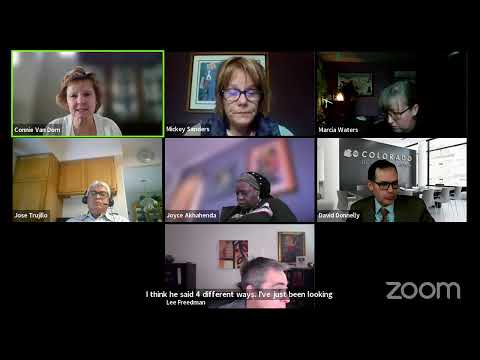 Click here to play video
January 16, 2024 HOA Homeowners' Rights Task Force Meeting
Click here to play video
January 16, 2024 HOA Homeowners' Rights Task Force Meeting
The Division of Real Estate and Department of Regulatory Agencies are pleased to present information on the HOA Homeowners' Rights Task Force members below:
Position | First Name | Last Name |
Ex Officio 1 (Chair) | Marcia | Waters |
Ex Officio 2 (DOLA Division of Housing) | Jose | Trujillo |
Ex Officio 3 (HOA Information Officer) | Nick | Altmann |
Speaker Appt. 1 | Joyce | Akhahenda |
Speaker Appt. 2 | Peter | Siegel |
Speaker Appt. 3 | Connie | Van Dorn |
Speaker Appt. 4 | Jesse | Loper |
Speaker Appt. 5 | Rep. Naquetta | Ricks |
Speaker Appt. 6 | Sen. Rhonda | Fields |
Governor Appt. 1 | Lee | Freedman |
Governor Appt. 2 | Richard | Brown |
Governor Appt. 3 | Lallis | Jackson |
The HOA Homeowners' Rights Task Force is an important opportunity for stakeholders, experts, industry professionals, and homeowners to come together to study and make recommendations concerning issues related to Common Interest Communities.
-
August 01 2023
-
October 24 2023
-
November 21 2023
-
December 20 2023
-
January 02 2024
Thank you for visiting the community engagement tool for the HOA Homeowners’ Rights Task Force.
Pursuant to HB23-1105, this project has now concluded. On behalf of the Department of Regulatory Agencies and the Division of Real Estate, thank you for your interest and participation.