HOA Homeowners' Rights Task Force
Thank you for visiting the community engagement tool for the HOA Homeowners’ Rights Task Force.
Pursuant to HB23-1105, this project has now concluded. On behalf of the Department of Regulatory Agencies and the Division of Real Estate, thank you for your interest and participation.

We're looking for your feedback on how HOAs are working here in Colorado.
The Colorado General Assembly recently passed HB23-1105: HOA Rights Task Force, creating two task forces aimed to investigate and present written reports on issues affecting those that work or live in HOAs in Colorado.
The HOA Rights Task Force’s main priorities are to study issues confronting HOA homeowners' rights, including:
Homeowners' associations' fining authority and practices
Foreclosure practices
Communications with homeowners
Availability and method of making certain documents available to HOA homeowners in the association
If you live in Colorado and work or reside in a homeowners association – we ask you to take part in our HOA stakeholder engagement activities (below). By taking our community survey or submitting your personal story, you are helping to shape the future of HOAs in Colorado.
All responses collected will be used to inform a final report to be presented to the Colorado General Assembly, the Governor’s Office, and the public.
We're looking for your feedback on how HOAs are working here in Colorado.
The Colorado General Assembly recently passed HB23-1105: HOA Rights Task Force, creating two task forces aimed to investigate and present written reports on issues affecting those that work or live in HOAs in Colorado.
The HOA Rights Task Force’s main priorities are to study issues confronting HOA homeowners' rights, including:
Homeowners' associations' fining authority and practices
Foreclosure practices
Communications with homeowners
Availability and method of making certain documents available to HOA homeowners in the association
If you live in Colorado and work or reside in a homeowners association – we ask you to take part in our HOA stakeholder engagement activities (below). By taking our community survey or submitting your personal story, you are helping to shape the future of HOAs in Colorado.
All responses collected will be used to inform a final report to be presented to the Colorado General Assembly, the Governor’s Office, and the public.
Share Your HOA Story
How have you been impacted by an HOA?
Share your story and help us better understand how homeowner association rules or regulations have had a positive or negative impact on you. Feel free to share any concerns, complaints, ideas or advice that relates to your experience with HOA's in Colorado.
Thank you for sharing your story with the HOA Homeowners' Rights Task Force.
-
Share HOA/Custom Management Group troubles on Facebook Share HOA/Custom Management Group troubles on X (formerly Twitter) Share HOA/Custom Management Group troubles on Linkedin Email HOA/Custom Management Group troubles link
HOA/Custom Management Group troubles
by Lina, almost 3 years agoMy husband and I own a first floor condominium at 15594 e. Arizona Ave in Aurora. June 12th of this year a water leak developed causing continuous water intrusion into our unit through the month of June, for most of July and the first part of August. It was not until mid August that a leak detection company identified a water leak from a common drain line. The leak was repaired but the board and management company have not moved forward with any plans to replace significantly damaged exterior siding and worn roof. By the time plumbing repairs were completed... Continue readingMy husband and I own a first floor condominium at 15594 e. Arizona Ave in Aurora. June 12th of this year a water leak developed causing continuous water intrusion into our unit through the month of June, for most of July and the first part of August. It was not until mid August that a leak detection company identified a water leak from a common drain line. The leak was repaired but the board and management company have not moved forward with any plans to replace significantly damaged exterior siding and worn roof. By the time plumbing repairs were completed, the rainy season had ceased. In the meantime, our unit sustained significant damage due to the spread of mold which has also affected adjoining units. The association is accepting financial responsibility for restoring the unit but by failing to replace terribly damaged siding and worn roof, they are not in compliance with established covenants. Neglect of common exterior surfaces will produce similar circumstances next time we experience a rainy season. The value and desirability of our property as well as the general health, safety and welfare of the building inhabitants is being adversely affected. -
Share Artificial Grass still being denied on Facebook Share Artificial Grass still being denied on X (formerly Twitter) Share Artificial Grass still being denied on Linkedin Email Artificial Grass still being denied link
Artificial Grass still being denied
by ColDrSunshine, almost 3 years ago
In a state where water is a premium and the advancement in artificial grass is so good that you can rarely tell it is artificial until the winter months, I would think there wouldn’t be any issues installing artificial turf. However my HOA has denied my request (pictured here) because CO law says they can’t deny placement in the “rear” of the house but they don’t consider this the rear of my home. Ambiguous terms are allowing the HOA to continually play judge, jury, and executioner. This area certainly isn’t the front of my house and it can’t be seen... Continue reading
In a state where water is a premium and the advancement in artificial grass is so good that you can rarely tell it is artificial until the winter months, I would think there wouldn’t be any issues installing artificial turf. However my HOA has denied my request (pictured here) because CO law says they can’t deny placement in the “rear” of the house but they don’t consider this the rear of my home. Ambiguous terms are allowing the HOA to continually play judge, jury, and executioner. This area certainly isn’t the front of my house and it can’t be seen from the road or even behind my house (and the area is completely fenced) so their point of refusal is ridiculous and merit less unless they just don’t want turf installed. They have no problem if I wish to place grass here but not artificial turf. This was designed as a play area for my grand children which keeps them separated from the firepit and pools but now I can’t do anything because of a difference of opinion on what “rear” actually means!!
-
Share HOA Lifecycle: Permanently Shifting the Control from the Board to the Homeowners. on Facebook Share HOA Lifecycle: Permanently Shifting the Control from the Board to the Homeowners. on X (formerly Twitter) Share HOA Lifecycle: Permanently Shifting the Control from the Board to the Homeowners. on Linkedin Email HOA Lifecycle: Permanently Shifting the Control from the Board to the Homeowners. link
HOA Lifecycle: Permanently Shifting the Control from the Board to the Homeowners.
by johncdean, almost 3 years agoI would like to present this white paper in person to the HOA Homeowners' Rights Task Force. My contact information is attached to my registration info.
White Paper: Home Owners Association Lifecycle Framework
Home Owners Associations have a 3 stage Lifecycle that may be generally described as:
Stage 1: Developer
Stage 2: Transition
Stage 3: Maturity
Developer Stage 1: The developer has total ownership interest (subject of course to financing and similar encumbrances) in undeveloped real estate. The developer has a plan that they wish to implement on the real estate. To execute on that plan, the developer must have... Continue reading
I would like to present this white paper in person to the HOA Homeowners' Rights Task Force. My contact information is attached to my registration info.
White Paper: Home Owners Association Lifecycle Framework
Home Owners Associations have a 3 stage Lifecycle that may be generally described as:
Stage 1: Developer
Stage 2: Transition
Stage 3: Maturity
Developer Stage 1: The developer has total ownership interest (subject of course to financing and similar encumbrances) in undeveloped real estate. The developer has a plan that they wish to implement on the real estate. To execute on that plan, the developer must have the ability to set the terms and conditions of what will be developed. Typically these terms and conditions specify who is allowed to build on the property and the scope and aesthetics of what may be built on the property. These terms and conditions are determined solely by the developer and are incorporated into the HOA documents. The Developer creates and controls the HOA Board and Documents. The purchaser determines if the HOA Documents are acceptable before the purchase is finalized.
Transition Stage 2: At this point, the developer has sold the majority of the developed properties. Now the control of the HOA Board and HOA documents shifts to the purchasers of the developed property. During this transition, any remaining undeveloped properties are developed and sold However, unlike the Developer, this transitional HOA Board has no financial interest in the properties being sold and should be limited to maintaining community property and ensuring that the final undeveloped lots are developed under restrictions compatible with the original HOA Documents.
Maturity Stage 3: This is the final stage in the HOA Lifecycle. The development is complete. The only financial interests in the development are the interests of the individual property owners. The developer is gone. The HOA Board has no financial interest in the development. The HOA Board and Documents should be focused strictly on the maintenance of any community property (parks, out-lots and the like). Individual properties must comply with the local governmental regulations but should not be subject to any interference from the HOA Board or Documents. At this stage all the rights of ownership are vested with the property owner.
Suggested Model Legal Structure:
Automatic Removal of Restrictions and Prohibition Against Adding New Restrictions
A restriction is anything that requires the property owner to use, not use, construct or maintain their property in a specific way. Requiring a specific building size, building style, building use, building color, building placement or easements would be example of restrictions.
Once the property is sold by the Developer to a Purchaser, no further restrictions may be placed on the property sold. This will prevent anyone from encumbering a property beyond how it was encumbered at the time the purchase was made.
If by pattern and practice a restriction is not uniformly enforced, it is considered dropped.
After 10 years all restrictions related to individual property are considered dropped. Restrictions and dues related to community property continue.
If a restriction is invalidated by any State or Local statute or final determination by a court, it is considered dropped
Once a restriction is dropped it is considered removed from any Documents it may not be reinstated. If the HOA Board tries to enforce a restriction that a property owner is able to show has been dropped, the property owner's costs including legal fees shall be paid by the HOA Board.
Dues, Liens, Fines and Penalties
The only property lien that is allowed is for unpaid HOA dues. The lien may not be foreclosed upon and may only be collected when the property is sold or transferred to another party. Interest (at 10% compounded annually) and lien costs would be part of the allowable dues lien amount.
The HOA Board has no authority to level fines or penalties. Code violations or similar issues should be referred to the local government authorities.
Property Owners Voting Rights
Any significant action of the HOA Board including changes to the Documents or rules enforcing those Documents must first be approved at the annual in person public meeting by 2/3 of the total number of homeowners present at the meeting for submission to all of the property owners. The action must then be approved by 2/3 of the property owners within the 60 days following the annual meeting (where the submission was approved) or it fails. These voting rights may not be removed, reduced or modified.
HOA Board and Committee Removal
The HOA Board (and any HOA Committees) may be removed at any annual, in person meeting, by a vote of 25% +1 of the property owners present or represented at any meeting.
The HOA Board (any any HOA Committees) may be removed by a petition for removal endorsed by 15% +1 of the property owners.
Public Policy
It is against public policy to restrict property use for a long period of time (rule against perpetuities) or to enforce ownership or restrictions when pattern and practice clearly indicate the restriction/ownership has lapsed (adverse possession).
It is against public policy to take the use of property without just compensation (lack of consideration), and any additional restrictions imposed after the property is sold by the Developer is a taking which lacks consideration.
As a matter of public policy, the judgment of the property owner which has a direct financial interest and incentive should supersede the judgement of the HOA Board which has no direct financial interest or financial risk.
As a matter of public policy, if the HOA Board through inappropriate action or inaction negatively impacts the property owners property value, that loss in value including costs and attorneys fees should be paid by the HOA Board.
As a matter of public policy, all property rights should vest with the property owner after 10 years. After 10 years, only community property should be managed and maintained by the HOA Board.
-
Share Life Plan Derailed for Years on Facebook Share Life Plan Derailed for Years on X (formerly Twitter) Share Life Plan Derailed for Years on Linkedin Email Life Plan Derailed for Years link
Life Plan Derailed for Years
by jwb, almost 3 years agoThis story isn't entirely new for DORA, as I've submitted complaints and such over the past few years, but I wanted to share it again in this form. We are currently in litigation with the HOA, after 4 years of non-cooperation to build a house on a vacant lot we own, so it is still unresolved.Years ago, the now wife and I were planning a future move to a ski town from the city, and in 2015 I bought the vacant lot in an HOA, as the HOA's rules seemed to be quite reasonable as written. In 2018 we... Continue reading
This story isn't entirely new for DORA, as I've submitted complaints and such over the past few years, but I wanted to share it again in this form. We are currently in litigation with the HOA, after 4 years of non-cooperation to build a house on a vacant lot we own, so it is still unresolved.Years ago, the now wife and I were planning a future move to a ski town from the city, and in 2015 I bought the vacant lot in an HOA, as the HOA's rules seemed to be quite reasonable as written. In 2018 we were married on the property, and planned to make it our future permanent home.
In April 2019, we contacted the HOA with a preliminary report of what we wanted to build, questions about building rules that were unclear from the HOA documents, and also to request a site visit with the HOA board a couple months from that point. As we are starting discovery, it appears that the property manager only forwarded the email to the HOA's architect, and didn't even bother sending it to the board until July of 2019, so we were mostly ignored for 4 months. In August 2019, we met with 2 board members, including our neighbor who had just joined the board, to go through our proposed build, with the primary goal to confirm the location of the house, as the lot has a limited area at the front of the lot where it is reasonable to build, as the middle/back of the lot is aspen grove, is sloped, and also has underlying shale close to the surface. During the site visit, it was confirmed that it was fine to locate the house right up to the front setback, but one board member (self proclaimed "I wrote the rules and know them better than anyone else") became aggressive when we said we were planning to use the full 35 feet of height allowed by the rules without a variance, claiming that the height limit was only 30 feet. We explained that the county had a different height rule, with a different measurement metric, that was 30 meet, but the HOA's height rule was indeed written as 35 feet, but were just met with agitation. We confirmed in a follow up email that the location at the front setback was fine, and proceeded with our preliminary plans based on this feedback. The HOA also said they would "expedite" our plans, given the 4 months delay from April to August.
In November 2019, we submitted preliminary plans, and only days afterwards the HOA sent out proposed changes to the building rules that dropped their height limit from 35 to 30 feet. We waited the 45 days that the covenants allow for the HOA to respond, and since we did not receive a response on our preliminary plans, emailed the HOA that we would continue to final plans based on our preliminary plans to try to be ready to build in spring 2020. We received aggressive responses from the HOA that the 45 day rule in the covenants did not apply to preliminary plans, and that our preliminary plans were incomplete because they did not include everything needed for final plans. Days later, they changed the height rule from 35 to 30 feet (despite the covenants requiring "uniform rules and procedures" for architectural control), and told us we needed a variance for our height after they retroactively changed the rules. A friend who is an attorney attempted to help us out, and instead of continuing work on our final plans, we spend the next 6 months going around in circles with the HOA before we realized they would not cooperate at all. In March 2020, our attorney was in a call with their attorney and the same board member who insisted the height rule was 30 instead of 35 feet, at which point the story changed that the height was not the issue, but the house location, and that it would block our neighbor's view of the mountain. I did a basic view analysis, and sent it to our neighbor (on the board), who said it looked fine to him, and he forwarded it to the board. For the next 3 years, the HOA and their attorney insisted that the view analysis I provided was inaccurate, and that our house would block our neighbor's view, without providing even so much as a picture as any sort of evidence or analysis. We received various arbitrary statements that we could drop the height to 30 feet, or move the house back 15 or 20 or 30 feet, but that would only increase the chances of approval.
By July 2020, we realized it was futile to try to get any sort of answers from the HOA, and so continued with our plans. Since we had delayed from January, people were no longer available to work on them (COVID didn't help), so instead of a few months to get the final plans done, it took about a year. I also made various information requests in accordance to CCIOA, and the HOA provided some information, but refused to provide much of the information, such as internal communications related to their actions with our preliminary plans. Some of the most important information I requested in 2020 and 2021 still has not been provided.
In August 2021, we submitted final plans. We received a notice of rejection from the HOA's attorney, based on that our plans were incomplete among other things. We were missing two minor details on the site plan (construction boundary, and that a small retaining wall would be rock), so I sent over these updates. At the end of October, we received a final rejection of our plans, claiming that we failed to request a height variance for the rule that was retroactively changed after we started the plan process, the impact to the neighbor, and other things, and failed to move the house or drop the height. We did drop the height slightly, and also dug it in about 3 feet further to try to mitigate the board's concerns, but they didn't even acknowledge that we made changes until early 2023. We also explained that the changes they demanded would mean we would have to completely redesign the house as far as we were concerned, and were unwarranted given that we had zero variances per the rules when we started in 2019, and had even met with the HOA before submitting plans to confirm the location and height, but they just continued to stonewall us.
In May 2022, we had a law firm send a demand letter, and also information requests, many of which were simply repeats of the refused information requests from 2020 and 2021. Despite giving the HOA's attorney a 2 week extension on the information requests beyond the 30 days allowed by CCIOA, we did not receive any of the information on time, and much was again refused. Our attorney asked for justification for the refusal, and was ignored. We still have unfilled information requests, some more than 3 years after we first formally requested information. In addition, the HOA has failed to hold board member elections in 2021, 2022, and 2023 in accordance to the bylaws. I ran for the board in 2022, since I had people tell me I should try to get in and fix things, and was one of 7 people running for 7 open positions- all positions were expiring. The HOA board failed to have a community election, reelected themselves, told me they would not elect me, and instead appointed someone else a month or two later. They did talk to me directly for the first time in 2 years (from June 2020 to June 2022 I communicated with the HOA's attorney, and the property manager, but the board itself never responded directly), and said they would contact me quickly and try to work things out. It took 1.5 months before they even contacted me, we met with a new board member on the property a bit later, and were told we could resubmit plans to the new board. After taking some time to get our plans from 2021 back to resubmit (the architect kept them instead of the HOA, despite the covenants only allowing "limited use" of an architect), we resubmitted plans the beginning of November 2022. We again waited the 45 days per the covenants, and didn't have a response. Finally, in January 2023, we got a short letter saying they were "working diligently" on our plans, but needed to have an independent view analysis done. This view analysis we were told months earlier in June 2022 was started and would take a month or two to complete, but still hadn't started. Finally, in March 2023, 3 years after we provided our view analysis, the new view analysis came back, and confirmed the one I provided in 2020 as accurate.
At this point, we were expecting to simply receive an approval note, but no, the HOA and attorney continued to do everything it could to prevent us from using our lot. They changed the building rules once again in March 2023, increasing the deposit from $2000 to $8000, and also changed the deposit rules that instead of a deposit to get a building permit, with no time limit from approval to start of build, that required the deposit immediately and loss of the deposit after 12 months. They initially tried to get me to agree to a settlement statement that forced the new rules retroactively, and also required me to sign away many of my rights as a property owner, including the right to information requests as a requirement for plan approval. When my attorney sent back what I would want in the settlement agreement, they flat out refused it all. They then tried to send me an "approval letter", which was in actuality a signature required legal document that again forced the $8k deposit, and said I would lose the deposit and all plans approval if building wasn't started in 12 months. Due to the excessive, 3+ year delay from the HOA, building costs have roughly doubled as well as interest rates (possibly increasing our costs by $1 million), so we are not currently in a position to build like we were in 2019-2020, and we have made this known to the HOA. These new, retroactive rules would effectively set us back to having nothing in 12 months, and be out $8k, so it became clear they still would not cooperate reasonably, so we filed a court complaint, which is just getting going now.
Overall, the HOA failed to follow it's own rules, tried to retroactively force new rules on us more than once after we submitted plans, has delayed us 3+ years, which threw our overall life planning into disarray. We still moved in 2021, but instead of having a place to move to, had to quickly find housing in a terrible, COVID market, with the stressful decision of whether to rent temporarily and hope the HOA would cooperate, or overpay for one of the few places on the market where we could live for the medium term. Luckily, we decided we could not trust the HOA to work with us, and managed to buy something that we could live in for a while. When we started the process in 2019, we were married less than a year and thinking about a family on our wedding property, and now, still without an approval of our plans, have a 3 year old and passed our 5 year wedding anniversary. The HOA has also refused to fully provide information requests per CCIOA, some of which are more than 3 years outstanding at this point. The HOA has also failed to hold elections for the past 3 years, and has instead self-elected, despite this being included in our court complaint. Instead of happy memories of our wedding on our property, it is now just something that depresses us, and if building costs don't come down, we may never be able to afford to build at this point due to the excessive delay from the HOA.
The state of Colorado needs to do some serious cracking down on HOA's, as they can have enormous negative impacts on citizens. We have heard many other horror stories from other people, from this HOA as well as other HOA's, including people who have moved from their longtime homes due to harassment from the HOA. The fact that citizens have zero recourse other than an expensive lawsuit to hold HOA's accountable is simply unacceptable, full enforcement of CCIOA needs to be handled by the state, otherwise HOA's will simply do whatever they want knowing that the majority of people have no resources to fight them in court. Fines and punishments also need to increase drastically, and more transparency required. Unless something qualifies for an executive session, all emails, texts, etc from HOA boards, everything should be required to be provided to members. In addition, instead of only an option to provide communications with an attorney to the community after a matter is concluded, HOA's should be fully required to provide all communications and such with the HOA's attorney to the members, so that members can see what their money is spent on. For litigation, it can be delayed until the litigation is concluded, but should be required for anything that has concluded. HOA's currently in a way have more power than local governments, as they cannot be held accountable for their actions through reasonable means, and have the ability to absolutely destroy the quality of life of the citizens who live in HOA's. I realize that most HOA's do not act in this way (I was on and off an HOA board for a condo complex several years ago, so know how one should operate), but the ones that do harass, discriminate, and negatively impact their members need to be forcefully held accountable by the state. Otherwise many, many Colorado citizens all over the state will continue to suffer needlessly because their government has failed to take action against these HOA's that are destroying their lives.
-
Share HOA Board Violates Policies on Facebook Share HOA Board Violates Policies on X (formerly Twitter) Share HOA Board Violates Policies on Linkedin Email HOA Board Violates Policies link
HOA Board Violates Policies
by BillThom, almost 3 years agoAs the owner of a condo in Southeast Denver and consequently an HOA member, I was involved in a dispute with the HOA Board of Directors.
The HOA in question held an election for the purpose of recalling a member of the board of directors. This election was not conducted in a proper manner and was in violation of the by-laws of the HOA and in violation of election procedures prescribed in the CRS.
The election ballots were sent out a week for more before the board meeting where the board member who was being recalled was given a chance... Continue reading
As the owner of a condo in Southeast Denver and consequently an HOA member, I was involved in a dispute with the HOA Board of Directors.
The HOA in question held an election for the purpose of recalling a member of the board of directors. This election was not conducted in a proper manner and was in violation of the by-laws of the HOA and in violation of election procedures prescribed in the CRS.
The election ballots were sent out a week for more before the board meeting where the board member who was being recalled was given a chance to defend himself. People were able to vote to recall him before he had a chance to present his side of the case.
I sent the Board of Directors a “cease and desist” letter, which was ignored. I did not even receive a response from their attorney. I was then informed by my attorney that I had no standing to sue since there was no financial remedy to be had. The remedy I was seeking was a proper and fair election, not a financial reward.
In the process of trying to force a fair election, I made the startling discovery that no one in state government is responsible for the proper conduct of HOAs. All the agencies I contacted, and I contacted quite a few, claim that it is not their responsibility. There is an agency that is set up to “monitor” HOAs, but no one wants to call the HOAs to order. The city tells me they don’t either.
It seems to me that if HOAs are quasi-governmental agencies and that they are supposedly bound by the CRS, that there should be a way to hold them accountable for following their own guidelines WITHOUT having to resort to the expense of taking them to court. I have invested several thousand dollars of my own money trying to force them to follow their election guidelines but have been told that since they ignored my “cease and desist” letter, I have no standing to sue since there is no financial remedy (just an issue of fairness and honesty.)
Why is there no agency or department to which improper conduct by an HOA can be remedied?
-
Share Amateur Hour and Power Struggles Abound in HOAs on Facebook Share Amateur Hour and Power Struggles Abound in HOAs on X (formerly Twitter) Share Amateur Hour and Power Struggles Abound in HOAs on Linkedin Email Amateur Hour and Power Struggles Abound in HOAs link
Amateur Hour and Power Struggles Abound in HOAs
by HOAIssues, almost 3 years agoIt would be nice if there were just one unifying problem within HOAs. Unfortunately, there are far too many. For starters, HOA attorneys should be required to represent the HOA as an entity. Instead, they represent the Board of Directors. Their involvement often helps foment dissension and encourages authoritian processes. They help write the HOA laws and they make money explaining the laws and/or often sending threatening letters to homeowners.
HOA attorneys also turned themselves into debt collectors, charging their exborbitant attorney fees to homeowners already facing the prospect of foreclosure. Many times neighbors are willing to help work out... Continue readingIt would be nice if there were just one unifying problem within HOAs. Unfortunately, there are far too many. For starters, HOA attorneys should be required to represent the HOA as an entity. Instead, they represent the Board of Directors. Their involvement often helps foment dissension and encourages authoritian processes. They help write the HOA laws and they make money explaining the laws and/or often sending threatening letters to homeowners.
HOA attorneys also turned themselves into debt collectors, charging their exborbitant attorney fees to homeowners already facing the prospect of foreclosure. Many times neighbors are willing to help work out these problems by establishing a payment plan instead of jumping to foreclosure, BUT since the attorneys make a lot of money foreclosing on properties that is their preferred method of collecting. Is this really how people want to treat neighbors?
Financial disclosures are required but often financials are not given and many times when given are incomplete. An open books policy should be required to ensure homeowners are properly informed of financial decisions being made on their behalf. What exactly is the justification of hiding financial information? If HOA Boards take the time to build community and work together with homeowners almost any reasonable and necessary replacement, repair or maintenance will be approved. Problems are created when HOA Boards exceed their authority, don't plan adequately and/or keep homeowners in the dark.Even developers are disallowed from adding common elements without holding a meeting of the membership to approve new additional elements. HOA Board of Directors should be held to the same standard. There are too many incidents of Board of Director "pet projects", such as additional pickleball courts, bocce, basketball courts, gazebos, etc. being approved without a vote of the membership. These new elements, which were not in the original plan, require maintenance, replacement and/or repair in prepetuity!
Election of officers must be trustworthy. Proxies especially for elections must be disallowed. Private ballots must be secured by ballot box and properly counted at a public meeting or possibly electronically submitted and counted by an outside independent source.
Changing the Declaration should require a positive vote of 60% of the membership. The current threshold is too high.
I hear complaints about neighbors not understanding the rules, yet Boards ofen don't understand their responsibilities. Board training should be required. It's not that difficult.
-
Share Potential homeowners should have to sign the house rules that they understand and will abide by them on Facebook Share Potential homeowners should have to sign the house rules that they understand and will abide by them on X (formerly Twitter) Share Potential homeowners should have to sign the house rules that they understand and will abide by them on Linkedin Email Potential homeowners should have to sign the house rules that they understand and will abide by them link
Potential homeowners should have to sign the house rules that they understand and will abide by them
by MonicaNY, almost 3 years agoI owned a condo in Breckenridge Colorado, I have one in Florida and I live in New York. I have a lot of experience with co-ops and condos. We don’t really have a choice per se, but they operate similarly. At each of those places I had a copy of the house rules prior to signing the contract, and when it got closer to the closing date, I had to be interviewed.(in NY and FL) By the board members. It was less of an interview -more of a meet and greet,- but one of the obligations was that I had... Continue reading
I owned a condo in Breckenridge Colorado, I have one in Florida and I live in New York. I have a lot of experience with co-ops and condos. We don’t really have a choice per se, but they operate similarly. At each of those places I had a copy of the house rules prior to signing the contract, and when it got closer to the closing date, I had to be interviewed.(in NY and FL) By the board members. It was less of an interview -more of a meet and greet,- but one of the obligations was that I had to discuss the house rules with the board and then sign the letter, saying I understood them and agreed. It really minimizes the issues later on, when someone says I didn’t know! Because there is no reason not to know. Might be something to consider. Knowing where the guest parking is, knowing who to send your monthly, check to, when elections are held, are there, committees for projects, all those things are really helpful in creating a sense of community. And when you think about it, people come from all walks of life and all industries, and have all types of work experiences that could be so helpful to the board. Not everyone wants to be on a board, but to be a volunteer for specific project, that would be very helpful.
-
Share Nonresident owners rights? on Facebook Share Nonresident owners rights? on X (formerly Twitter) Share Nonresident owners rights? on Linkedin Email Nonresident owners rights? link
Nonresident owners rights?
by MonicaNY, almost 3 years agoAfter reading Richard’s remarks about corporations, buying up many units, and then impacting the quality of life for the local resident homeowners, I wanted to share this tidbit.
Apparently in a condo that I own in Florida, we do have rental restrictions and a minimum rental term of three months. It’s in a beach community, so there are a lot of winter snowbirds coming down. If I rent my unit out for the three month minimum. I have to give up my rights to the common areas, like the clubhouse and pool, and those rights are, then transferred to the... Continue readingAfter reading Richard’s remarks about corporations, buying up many units, and then impacting the quality of life for the local resident homeowners, I wanted to share this tidbit.
Apparently in a condo that I own in Florida, we do have rental restrictions and a minimum rental term of three months. It’s in a beach community, so there are a lot of winter snowbirds coming down. If I rent my unit out for the three month minimum. I have to give up my rights to the common areas, like the clubhouse and pool, and those rights are, then transferred to the tenant for use of those amenities. So we have a harbor area with about 50 boat slips, and if one of those boat owners decides to rent out his apartment, he hast to remove his boat. Regardless of whether the Renter brings a boat or is supposed to use the owners Boat, he cannot keep his boat on the dock if he rents out the apartment. Interesting, right?The owner still has voting rights, but he just cannot use the amenities. We also have a limit of any one owner can only own up to three apartments in the 400 unit development.
-
Share H.O.A. Members Are → Not ← Neighbors on Facebook Share H.O.A. Members Are → Not ← Neighbors on X (formerly Twitter) Share H.O.A. Members Are → Not ← Neighbors on Linkedin Email H.O.A. Members Are → Not ← Neighbors link
H.O.A. Members Are → Not ← Neighbors
by Robert Racansky, almost 3 years ago
the fact that after developer turnover all HOA members are neighbors
- rlinquanti, "HOA Members Are Neighbors", September 30 2023
Wrong.
Some H.O.A.s -- especially condominium associations -- have a high number of non-resident investor owners. *
Non-resident owners can make up a large plurality, or even a majority, of owners.
Some owners are even corporate entities and not natural persons.
The interests of non-resident owners do not necessarily coincide with the interests of the resident-owners who live in H.O.A.-burdened communities.
- e.g., For investment owners, H.O.A. fees are a tax write-off and/or a cost passed on to... Continue reading
the fact that after developer turnover all HOA members are neighbors
- rlinquanti, "HOA Members Are Neighbors", September 30 2023
Wrong.
Some H.O.A.s -- especially condominium associations -- have a high number of non-resident investor owners. *
Non-resident owners can make up a large plurality, or even a majority, of owners.
Some owners are even corporate entities and not natural persons.
The interests of non-resident owners do not necessarily coincide with the interests of the resident-owners who live in H.O.A.-burdened communities.
- e.g., For investment owners, H.O.A. fees are a tax write-off and/or a cost passed on to their renters. But for resident owners, especially seniors and others living on a fixed-income, rising H.O.A. fees represents a hardship that could make their home unaffordable.
- e.g., An investment group that owns a majority of units can -- and do -- take control of an H.O.A., with disastrous results for the residents.
- e.g., An owner trying to organize neighbors to take some form of collective action will have a difficult (and expensive) time doing so when a large plurality of so-called "neighbors" are not residents. I speak from personal experience. **
What percentage of owners in each H.O.A. is a non-resident investor owner? A corporate entity?
The State of Colorado does not track such information, because our policy makers do not want to know the answer.
At the very least, our legislators should consider making it illegal for non-resident owners to be Directors & Officers of so-called "Community Associations" / "Common Interest Communities". *** Which are really corporations, not communities. But if we are going to pretend that H.O.A. corporations are communities, they should at the minimum be governed by those who actually live in the community.
* As far as I know this has not yet become an issue with single-family home H.O.A. corporations. Yet. But with private equity investment firms like BlackRock and Vanguard buying large swathes of housing, give it a decade or two.
** For example, click → here ← for a "Motion of Continuance" I filed on behalf of owners opposed to amending the Declaration. In most of the cases where the non-resident owner was a corporate entity, I didn't even know who to contact. Organizing owners, especially when a large plurality -- I think it was above 40% -- are non-residents, to take collective action is something I never want to do again.
*** This policy proposal should also be applicable to Metro Districts.
-
Share Who Are The Stakeholders? on Facebook Share Who Are The Stakeholders? on X (formerly Twitter) Share Who Are The Stakeholders? on Linkedin Email Who Are The Stakeholders? link
Who Are The Stakeholders?
by Robert Racansky, almost 3 years agoWhen the Founding Fathers wrote the Declaration of Independence, they did not ask for King George’s input.
So why is an “H.O.A. Homeowners Rights Task Farce” made up of parties whom consumers of H.O.A.-burdened housing need protecting from?
i.e., H.O.A. managers, H.O.A attorneys, H.O.A. board members, and developers.
To add insult to injury, the “homeowner advocate” position has been filled by a board member of the local chapter of the Communisty Associations Institute; the lobby organization for H.O.A managers, H.O.A. attorneys, and other H.O.A. vendors.
A task force to review issues related to a non-profit association of *homeowners*... Continue reading
When the Founding Fathers wrote the Declaration of Independence, they did not ask for King George’s input.
So why is an “H.O.A. Homeowners Rights Task Farce” made up of parties whom consumers of H.O.A.-burdened housing need protecting from?
i.e., H.O.A. managers, H.O.A attorneys, H.O.A. board members, and developers.
To add insult to injury, the “homeowner advocate” position has been filled by a board member of the local chapter of the Communisty Associations Institute; the lobby organization for H.O.A managers, H.O.A. attorneys, and other H.O.A. vendors.
A task force to review issues related to a non-profit association of *homeowners* should be represented by homeowners *with no* conflicts of interest linked to the for profit entities that benefit commercially from the dues paid by the non-profit members of the association. I refer to the for-profit declarants, developers, and contractors (commercial management and service providers) who carry extraordinarily lopsided influence over our non-profit homeowner communities.
- Gary Helfeldt, written testimony regarding Colorado House Bill HB23-1105, “H.O.A. Homeowners Rights Task Farce”, February 16 2023
The Colorado Department of Regulatory Agencies (DORA) has an incredibly distorted opinion of who the “stakeholders” of H.O.A.-burdened housing should be.
In 2019, Governor Jared Polis directed DORA to
to lead a stakeholder process that will complete a comprehensive review of CAMs [communisty association managers] and HOAs. The Executive Director will consider, develop, and make recommendations on how to promote effective and efficient regulation of CAMs and HOAs, including the following:
A. The licensure of CAMs, considering recommendations from the the 2017 DORA sunset report, and whether licensure is needed to protect consumer safety and is cost-effective;
B. Approaches that improve transparency among HOAs;
C. Methods to reduce costs and improve the transparency of HOA fees and fee schedules; and
D. Strategies to promote homeowner rights and consumer protections through an evaluation of the Colorado Common Interest Ownership Act and other related acts or rules.
- “Executive Order D 2019 006”, May 31 2019
In response to the Governor’s order, DORA conducted a “Stakeholder Survey”.
• Open Responses # 1 (Received through July 31, 2019)
• Open Responses # 2 (Received through August 30, 2019)
• Open Responses # 3 (Received through September 30, 2019
• Open Responses # 4 (Received through October 31, 2019)
Who does DORA consider to be the stakeholders in H.O.A. corporations? If you think that it would be the actual homeowners who pay the costs and bear the risks, you are wrong. Very wrong.
H.O.A. managers, board members, and attorneys - those that consumers of H.O.A.-burdened housing need protection from - made up a larger share of stakeholders than H.O.A-burdened homeowners : 42.3 % vs 38.3 %. And why are real estate brokers - another group whose interests don’t necessarily coincide with homeowners - considered stakeholders?
DORA claims that its mission is “protecting consumers”. But it is an impossible conflict of interest when the agency considers stakeholders to be those that consumers need protecting from.
After conducting the stakeholder survey, DORA published its 2019 Report Concerning the Governor’s Executive Order D-2019-006: Directing a Stakeholder Process to Examine Community and Homeowner Associations (December 2019).
Although the Governor ordered DORA to produce recommendations about
• the licensure of H.O.A. managers
• improve transparency
• reduce costs of H.O.A. fees, and
• promote homeowner rights and consumer protectionsonly the last four paragraphs on the last page are about “Recommendations regarding strategies to promote homeowner rights and consumer protections through an evaluation of the Colorado Common Interest Ownership Act and other related acts or rules”.
Because the real stakeholders in the policy making process are not the homeowners who bear the burdens and pay the costs, but those who profit off of them.
It’s a demonstration of how the inputs that go into the entire process of making H.O.A. law are skewed, and not in favor of homeowners.
Replace the current passive State Paradigm with an active one beginning at the point that a common ownership development is established.
All the developments in question are creatures of statute. As a consequence, the government has a special responsibility to protect the rights of those living in them. Owners are entitled to and desperately need a willing and activist State agency with the proper authority and responsibility to act publicly for the owners. It is important to recognize that these are two crucial and separate concepts. The designated State agency must act publicly and unequivocally in the owners’ best interests. Most importantly, no agency can have- or deserves- the owners’ trust if it is willing to work behind closed doors with any trade group lobbying in the interests of those profiting off of associations and which actively opposes any meaningful owner rights.
- Edward R. Hannaman, "Homeowner Association Problems and Solutions". Rutgers Journal of Law & Public Policy. Vol. 5 No. 4 Spring 2008. At page 718. Emphasis added.

-
 HOA Task Force Report with Appendices.pdf (58.4 MB) (pdf)
-
2023-12-08 HB23-1105 Task Force List of Considerations (1).pdf (150 KB) (pdf)
-
HOA TF Summary Report (2023-08-03 through 2024-04-07) Redacted.pdf (416 KB) (pdf)
-
HOA TF Detailed Report (2023-08-03 through 2024-04-07)_Redacted.pdf (5.12 MB) (pdf)

-
 Click here to play video
October 24, 2023 HOA Homeowners' Rights Task Force Meeting Recording
Click here to play video
October 24, 2023 HOA Homeowners' Rights Task Force Meeting Recording
-
 Click here to play video
November 21, 2023 HOA Homeowners' Rights Task Force Meeting
Click here to play video
November 21, 2023 HOA Homeowners' Rights Task Force Meeting
-
 Click here to play video
December 20, 2023 HOA Homeowners' Rights Task Force Meeting
Click here to play video
December 20, 2023 HOA Homeowners' Rights Task Force Meeting
-
 Click here to play video
January 2, 2024 HOA Homeowners' Rights Task Force Meeting
Click here to play video
January 2, 2024 HOA Homeowners' Rights Task Force Meeting
-
 Click here to play video
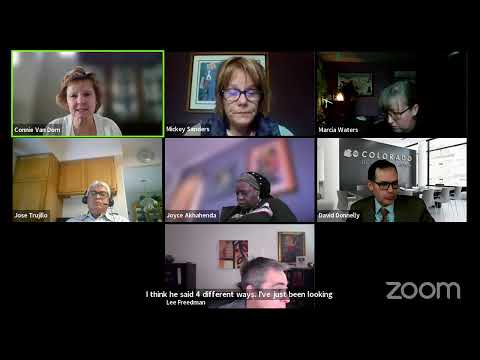
January 16, 2024 HOA Homeowners' Rights Task Force Meeting
Click here to play video
January 16, 2024 HOA Homeowners' Rights Task Force Meeting
The Division of Real Estate and Department of Regulatory Agencies are pleased to present information on the HOA Homeowners' Rights Task Force members below:
Position | First Name | Last Name |
Ex Officio 1 (Chair) | Marcia | Waters |
Ex Officio 2 (DOLA Division of Housing) | Jose | Trujillo |
Ex Officio 3 (HOA Information Officer) | Nick | Altmann |
Speaker Appt. 1 | Joyce | Akhahenda |
Speaker Appt. 2 | Peter | Siegel |
Speaker Appt. 3 | Connie | Van Dorn |
Speaker Appt. 4 | Jesse | Loper |
Speaker Appt. 5 | Rep. Naquetta | Ricks |
Speaker Appt. 6 | Sen. Rhonda | Fields |
Governor Appt. 1 | Lee | Freedman |
Governor Appt. 2 | Richard | Brown |
Governor Appt. 3 | Lallis | Jackson |
The HOA Homeowners' Rights Task Force is an important opportunity for stakeholders, experts, industry professionals, and homeowners to come together to study and make recommendations concerning issues related to Common Interest Communities.
-
August 01 2023
-
October 24 2023
-
November 21 2023
-
December 20 2023
-
January 02 2024
Thank you for visiting the community engagement tool for the HOA Homeowners’ Rights Task Force.
Pursuant to HB23-1105, this project has now concluded. On behalf of the Department of Regulatory Agencies and the Division of Real Estate, thank you for your interest and participation.